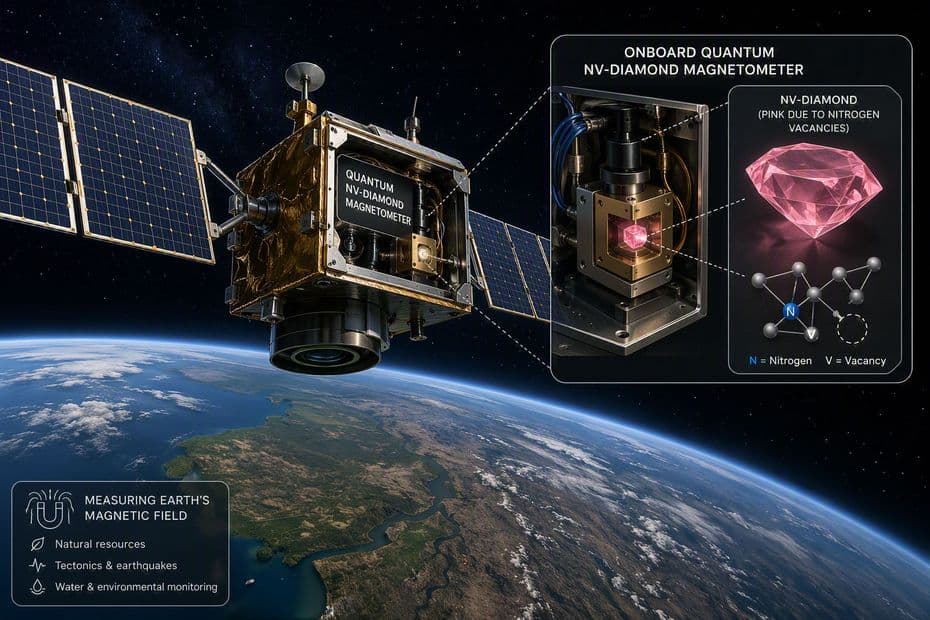
Kraków continues to strengthen its reputation as one of Europe’s leading research centres after scientists from Jagiellonian University joined an international project to develop a new generation of quantum magnetometers for space.
The initiative brings together researchers from the university’s Faculty of Physics, Astronomy and Applied Computer Science with aerospace company Honeywell Aerospace and quantum technology specialist Quantum Brilliance. Working under a programme funded by the European Space Agency (ESA), the consortium aims to design, test and deliver a compact quantum magnetometer by 2027.
The instrument will be used to measure Earth’s magnetic field from orbit with exceptional precision, supporting future scientific missions and Earth observation programmes.
Bringing Quantum Technology into Orbit
Although the technology behind the project is highly advanced, its purpose is straightforward. A magnetometer is an instrument that measures magnetic fields. From space, these measurements help scientists better understand Earth’s interior, monitor changes in the planet’s magnetic environment and expand our knowledge of the space surrounding Earth.
The new device is expected to offer high performance while remaining small, lightweight and energy efficient, all essential qualities for equipment carried aboard satellites.
Kraków Researchers Play a Key Scientific Role
Two research groups from Jagiellonian University are contributing specialist expertise to the project.
The team led by Professor Adam Wojciechowski is working with diamond-based nitrogen-vacancy (NV) centres, a technology that has become one of the most promising building blocks for next-generation quantum sensors.
Meanwhile, Professor Szymon Pustelny’s research group is developing the precision magnetometry techniques needed to ensure the sensor can produce stable, highly accurate measurements.
Researchers will also carry out extensive laboratory testing using the university’s specialist facilities, including a magnetically shielded room and ultra-precise optical magnetometers. These tests will allow the prototype to be evaluated under carefully controlled conditions before it is prepared for use in space.
A Partnership Combining Science and Engineering
Each organisation brings different strengths to the collaboration.
Honeywell Aerospace contributes its experience in designing hardware capable of operating in the demanding conditions of space, including engineering expertise from its research and development centre in Brno.
Quantum Brilliance provides its proprietary diamond quantum sensing technology, which operates at room temperature and is designed to deliver accurate three-dimensional magnetic field measurements using a single compact sensor. This simplifies the overall system while reducing calibration requirements, making it particularly well-suited to satellite missions where size, weight, and power consumption are tightly constrained.
By combining these technologies with Jagiellonian University’s research expertise, the consortium hopes to create a sensor capable of producing more detailed maps of Earth’s geomagnetic field while offering greater resistance to radiation during long-duration missions.
Benefits Beyond Scientific Research
While the immediate goal is to support ESA’s Earth observation and space science programmes, the technology could have wider applications.
Improved magnetic field measurements can contribute to:
- More detailed studies of Earth’s interior and geophysical processes.
- Better monitoring of changes in the planet’s magnetic environment.
- Enhanced Space Domain Awareness by helping monitor activity in Earth’s orbital environment.
- Smaller, lighter and more energy-efficient satellite instruments.
As satellites continue to play an increasingly important role in communications, navigation, environmental monitoring and scientific research, advances in compact quantum sensing technologies could become an important part of future space missions.
Another Milestone for Kraków’s Research Community
The collaboration highlights the growing international profile of Jagiellonian University in advanced physics and quantum technologies. Working alongside global industry partners and the European Space Agency places Kraków researchers at the forefront of a field expected to shape the next generation of scientific instruments.
The partners announced their collaboration on 14 July, with the project scheduled to deliver the completed quantum space magnetometer to ESA by 2027.
Source Click here for more latest news from Kraków!

