A Trumpet Call That Has Never Been Finished
Every hour of every day, a trumpet signal rises from the taller of two towers at St Mary’s Basilica in Krakow’s Main Market Square. The Hejnal mariacki, as it is called, breaks off abruptly mid-note, commemorating a medieval trumpeter who was shot in the throat while sounding the alarm before a Mongol attack on the city.
Origins of the Church
According to the chronicler Jan Dlugosz, the original church was founded in 1221 to 1222 by Bishop Iwo Odrowaz. That early building was destroyed during the Mongol invasion of Poland in 1241. A new early Gothic church was built on the remaining foundations between 1290 and 1300, and was consecrated in 1320.
The church was completely rebuilt during the reign of Casimir III the Great between 1355 and 1365, with substantial contributions from wealthy restaurateur Mikolaj Wierzynek. The presbytery was elongated and tall windows were added. The main vault was completed in 1395 to 1397 by master Nicholas Wernher from Prague.
Two Unequal Towers
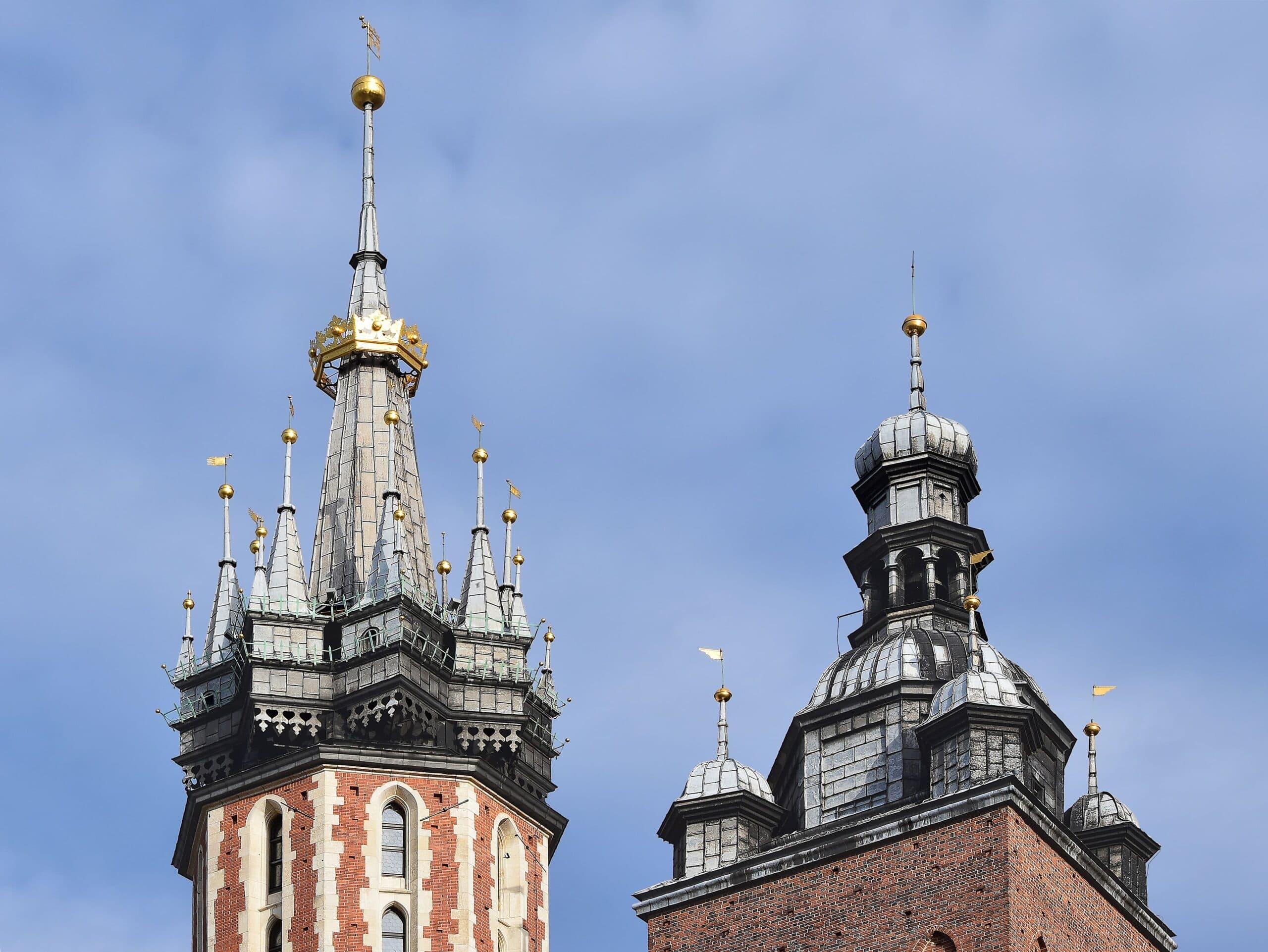
The basilica’s most distinctive feature is its pair of towers of different heights. The taller, at 80 metres, serves as the watchtower from which the Hejnal is played. The lower tower, by tradition, contains three bells. In 1478, carpenter Maciej Heringh funded a Gothic helmet for the taller tower, and a gilded crown was placed on it in 1666.
The differing heights of the towers are the subject of a local legend about two brothers who each built a tower. According to the tale, when one brother grew jealous of the other’s superior work, he stabbed his sibling and threw himself from the tower in remorse.
The Veit Stoss Altarpiece
At the end of the 15th century, the church received what is considered a masterpiece of late Gothic sculpture, the Altarpiece of Veit Stoss. The massive polyptych, carved from linden wood and oak, is the largest Gothic altarpiece in the world. It stood in the church for centuries before being hidden during the Second World War, only to be rediscovered in Bavaria and returned to Krakow.
Some of the basilica’s monumental polychrome murals were designed by Poland’s leading history painter, Jan Matejko, who worked with Stanislaw Wyspianski and Jozef Mehoffer on stained glass in the presbytery during the 1887 to 1891 restoration.
The Hejnal Tradition
The origin of the Hejnal is linked to the 1241 Mongol invasion. According to tradition, a watchman in the taller tower spotted approaching Tatar warriors and began to play his trumpet to warn the city. The alarm was sounded, but the trumpeter was struck by an arrow before completing the melody. The tune has been played in his memory ever since, stopping abruptly at the note where the original trumpeter fell.
The noon-time Hejnal is broadcast live across Poland by Polish Radio Jedynka, a tradition that has continued since 1927. The signal has also been broadcast internationally by radio stations around the world.
Local Significance
For residents of Krakow, the Hejnal is not merely a tourist attraction but a deeply embedded part of the city’s identity. The sound can be heard across the Old Town, and many locals pause to listen for it. In 2010, a funeral ceremony for Polish president Lech Kaczynski and his wife Maria was held in the basilica, before the coffins were transported to Wawel Cathedral.
The basilica served as an architectural model for many Polish diaspora churches, particularly in Chicago, including Saint Michael’s and Saint John Cantius, designed in the Polish Cathedral style.
**What Is Confirmed:** The church’s founding date, the Hejnal tradition, and the altarpiece’s history are well documented in historical records and the basilica’s own archives.
**What Is Unclear:** The exact date of the original church’s destruction varies between sources, with some placing it during the Mongol invasion and others during a later fire.