How Italian Artists and Architects Transformed Krakow in the 16th Century
The Polish Renaissance, which flourished from the late 15th to the early 17th century, brought a wave of Italian artists, architects and sculptors to Krakow who transformed the city’s appearance and left a lasting mark on its cultural landscape. The influence of Italian Renaissance art and architecture is still visible throughout the city today.
The Jagiellonian Court
The Renaissance first arrived in Poland through the Jagiellonian court. King Sigismund I the Old, who reigned from 1506 to 1548, and his Italian-born wife Queen Bona Sforza were instrumental in bringing Italian culture to Krakow. Bona Sforza, daughter of the Duke of Milan, brought with her a retinue of Italian artists, architects and musicians.
The royal couple’s patronage attracted a steady stream of Italian talent to Krakow. Among the most notable arrivals were Francesco Fiorentino, who worked on the Sigismund Chapel, and Bartolommeo Berrecci, who designed the chapel and other royal projects.
Wawel Castle’s Renaissance Courtyard
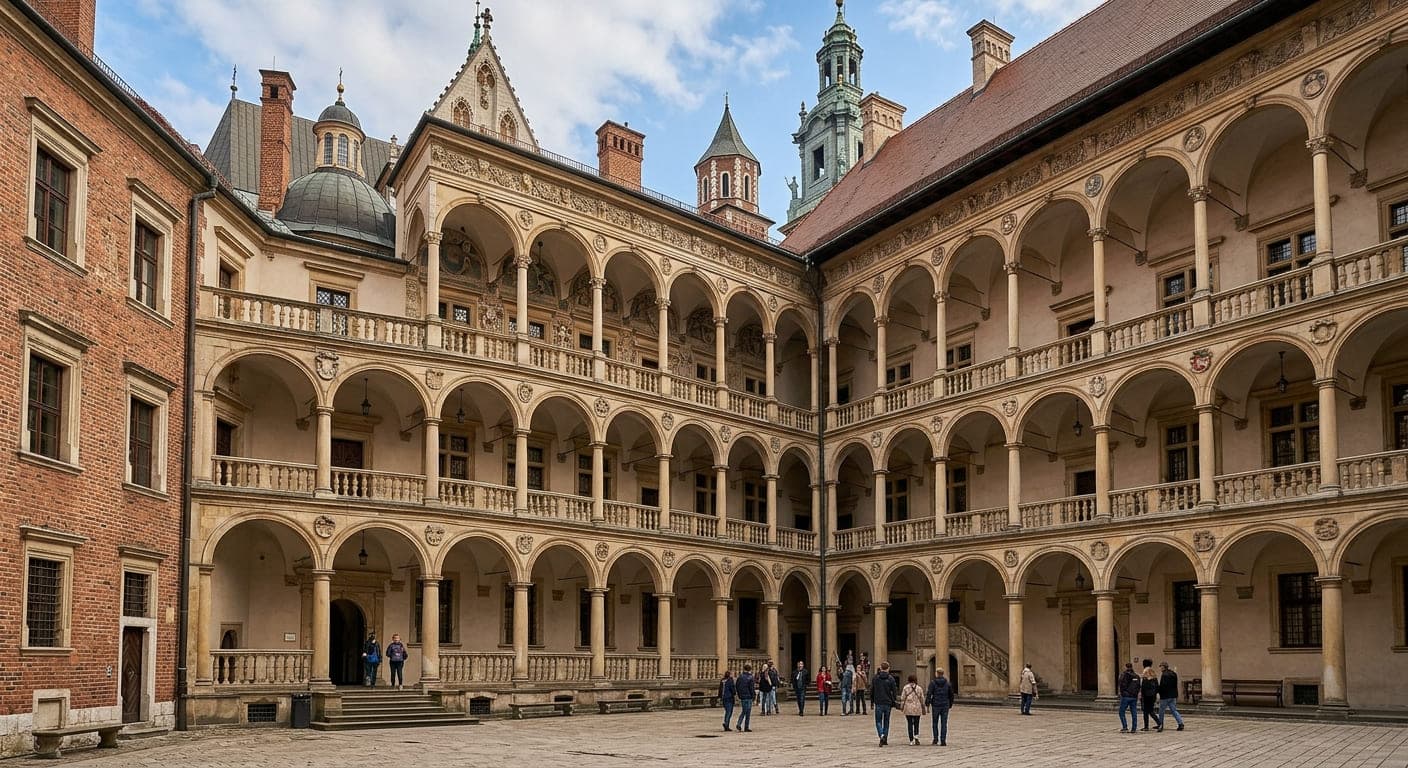
The most significant architectural achievement of the Polish Renaissance in Krakow was the reconstruction of Wawel Castle. Following a fire in 1499, Sigismund I commissioned Italian architects to rebuild the royal residence in the Renaissance style.
The result was the arcaded courtyard that still stands today, with its tiered galleries inspired by Italian palazzo design. However, the architects adapted Italian forms to Polish conditions, creating a distinctly Polish Renaissance style. The uppermost arcade was built higher than those below, a feature unknown in Italy, giving the courtyard a uniquely Polish character.
The Sigismund Chapel
The Sigismund Chapel at Wawel Cathedral, constructed from 1517 to 1533, is considered one of the finest examples of Tuscan Renaissance architecture north of the Alps. Designed by Bartolommeo Berrecci, the chapel features a golden dome and intricate sculptural decoration by Italian and Polish craftsmen.
The chapel houses the tombs of Sigismund I, his son Sigismund II Augustus, and Queen Anna Jagiellon. Its design combines Italian Renaissance forms with local artistic traditions, creating a harmonious blend of styles.
Churches and Public Buildings
Italian influence extended beyond the royal court to churches and public buildings throughout Krakow. The Church of St Anne, rebuilt in the Renaissance style in the 16th century, features an Italian-style facade and interior decoration. The Cloth Hall was reconstructed in the Renaissance style following a fire in 1559.
Italian artists also worked on numerous private residences and palaces for the Polish nobility, introducing Renaissance decorative elements such as pilasters, cornices and classical motifs to Krakow’s architecture.
The Jagiellonian Tapestries
While not Italian in origin, the Jagiellonian tapestries purchased by Sigismund II Augustus reflect the Renaissance taste for elaborate decorative art. Woven in the Netherlands and Flanders, many based on designs by Michiel Coxie, the tapestries were among the most valuable possessions of the Polish royal court.
The collection, which originally numbered over 350 pieces, included scenes from the Old Testament, landscapes, hunting scenes and grotesques. Today, a significant portion of the collection is displayed at Wawel Castle.
Local Significance
For residents of Krakow, the Renaissance heritage is an integral part of the city’s identity. The arcaded courtyard of Wawel Castle, the Sigismund Chapel, and the reconstructed Cloth Hall are among the most visited landmarks in the city. The fusion of Italian and Polish artistic traditions created a distinctive style that continues to define Krakow’s architectural character.
**What Is Confirmed:** The arrival of Italian artists, the reconstruction of Wawel Castle, and the Sigismund Chapel are well documented.
**What Is Unclear:** Some specific attributions of architectural works vary between sources.