Explore the fascinating history of Jagiellonian University, Poland’s oldest university and one of Europe’s oldest centres of learning, and explore how it has shaped Kraków for more than 650 years.
Walk through the cobbled streets of Kraków’s Old Town and it quickly becomes clear that this is a city where history is never far away. Gothic churches stand beside Renaissance palaces, medieval gateways lead to lively cafés, and centuries-old courtyards continue to welcome visitors from around the world. Among these landmarks is one institution that has quietly shaped the city for more than six and a half centuries: Jagiellonian University.
Founded in 1364, Uniwersytet Jagielloński is the oldest university in Poland and one of the oldest continuously operating universities in Europe. Long before modern campuses and international exchange programmes, scholars travelled across the continent to study in Kraków, helping to establish the city as one of medieval Europe’s most important centres of learning.
Today, more than 650 years after its foundation, the university remains a defining part of Kraków’s identity. Its historic colleges attract visitors throughout the year, while its lecture halls, laboratories and libraries continue to educate thousands of students from Poland and abroad. Understanding the history of Jagiellonian University is also a way of understanding the story of Kraków itself.
The Vision of a King
The university owes its origins to King Casimir III the Great, the last monarch of the Piast dynasty and one of Poland’s most influential rulers. During the fourteenth century, universities were becoming increasingly important across Europe. They educated lawyers, physicians, theologians and administrators who helped govern kingdoms and advance knowledge in an age of rapid intellectual development.
Recognising the need for a centre of higher learning within his own kingdom, Casimir founded a studium generale in Kraków on 12 May 1364. It was only the second university established in Central Europe after Prague and reflected the kingdom’s growing political and economic ambitions.
The original institution consisted of three faculties:
- Law
- Medicine
- Liberal Arts
Law was particularly important, as Poland required well-trained legal scholars to support its expanding administration. Medicine offered opportunities to improve healthcare in the kingdom, while the liberal arts provided students with the broad education expected before advancing to specialised study.
The decision to establish the university transformed Kraków from a royal capital into a recognised centre of scholarship. Students and teachers brought new ideas, international connections and intellectual prestige, helping to lay the foundations for the city’s future reputation.
A Period of Uncertainty
Despite its promising beginning, the university’s early years proved challenging.
Following the death of Casimir the Great in 1370, royal patronage weakened considerably. Without strong financial support and political backing, many academic activities slowed, and the institution struggled to maintain the momentum of its first years.
Unlike today, medieval universities depended heavily on the support of monarchs and the Church. Their survival often reflected the political stability of the kingdoms in which they operated. For several decades, Kraków’s university faced an uncertain future.
Its revival would come thanks to one of the most remarkable figures in Polish history.
Queen Jadwiga’s Enduring Legacy
Queen Jadwiga, crowned Queen of Poland in 1384, remains one of the country’s most respected historical figures. Although her reign lasted only a decade, her influence reached far beyond politics.
Understanding the importance of education for the kingdom’s future, Jadwiga arranged for a significant portion of her personal wealth to be left to the university upon her death in 1399. Her bequest provided the financial resources needed to restore and expand the institution.
Her husband, King Władysław Jagiełło, fulfilled her wishes by officially renewing the university in 1400.
The reopening marked a turning point not only for the university but also for Polish higher education. A Faculty of Theology was added alongside the existing disciplines, creating the traditional four-faculty structure common among Europe’s leading medieval universities.
The university later became known as Jagiellonian University in recognition of the Jagiellonian dynasty, whose patronage helped secure its place among Europe’s respected academic institutions.
Even today, Queen Jadwiga’s contribution is remembered as one of the most significant acts of educational philanthropy in Polish history. Her vision ensured that the university would survive long enough to become one of the country’s greatest national treasures.
Kraków Becomes a City of Scholars
As the fifteenth century progressed, Kraków experienced what many historians regard as one of its great golden ages.
The city flourished politically, economically and culturally as the capital of the Kingdom of Poland. Merchants traded in the Market Square, artists decorated churches and public buildings, while scholars gathered in university colleges to debate philosophy, science and law.
Students arrived from across Central and Eastern Europe, bringing with them different languages, customs and ideas. Latin served as the common language of learning, allowing scholars from many countries to study together despite their different backgrounds.
This international character became one of the university’s defining strengths and contributed significantly to Kraków’s growing importance as a European centre of education.
Many of the streets surrounding today’s Collegium Maius still follow the same medieval layout walked daily by generations of students more than 500 years ago. While cafés and bookshops have replaced many of the old workshops and merchants’ houses, the atmosphere of learning remains an unmistakable part of this corner of the city.
The Birthplace of Great Minds
During the fifteenth and early sixteenth centuries, Jagiellonian University gained an international reputation for mathematics, astronomy, philosophy and law.
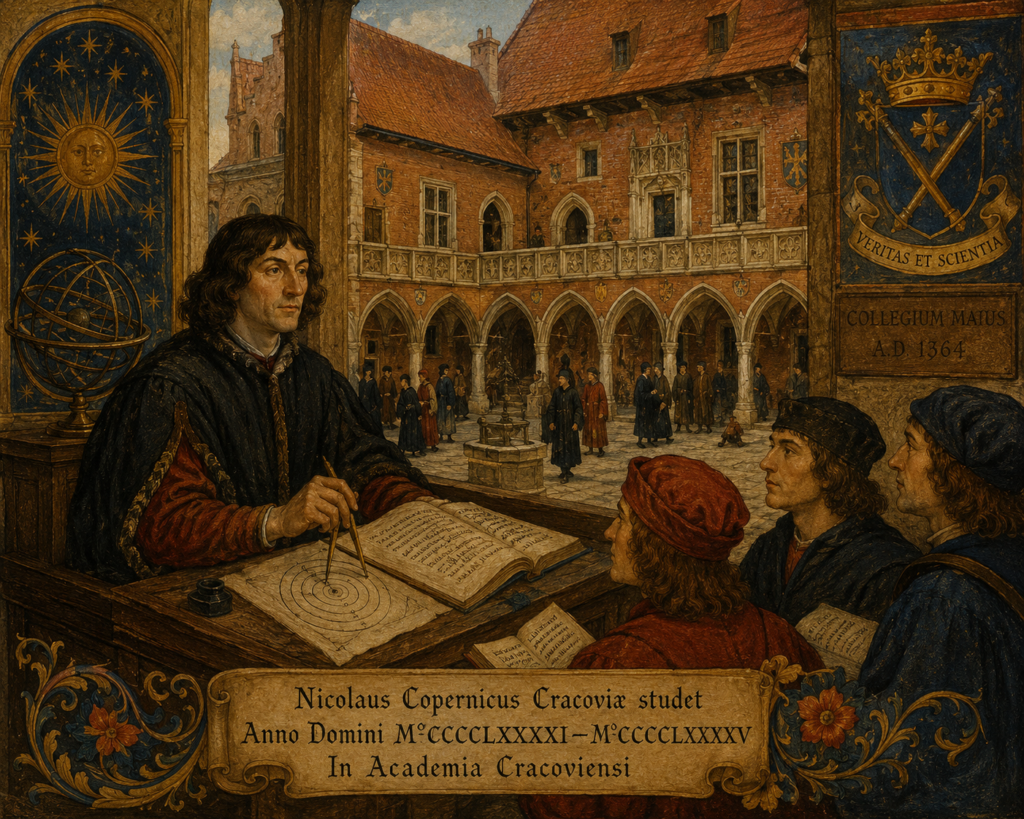
Perhaps its best-known student was Nicolaus Copernicus, who enrolled at the university in 1491. Although he did not complete a degree in Kraków, his years at the university introduced him to mathematics and astronomy, subjects that would later underpin his revolutionary model of the solar system.
Copernicus is only one of many distinguished figures associated with the university. Across the centuries, its lecture halls have educated kings, scientists, writers, physicians, artists and future national leaders. Their achievements helped establish the institution as one of Europe’s enduring centres of scholarship.
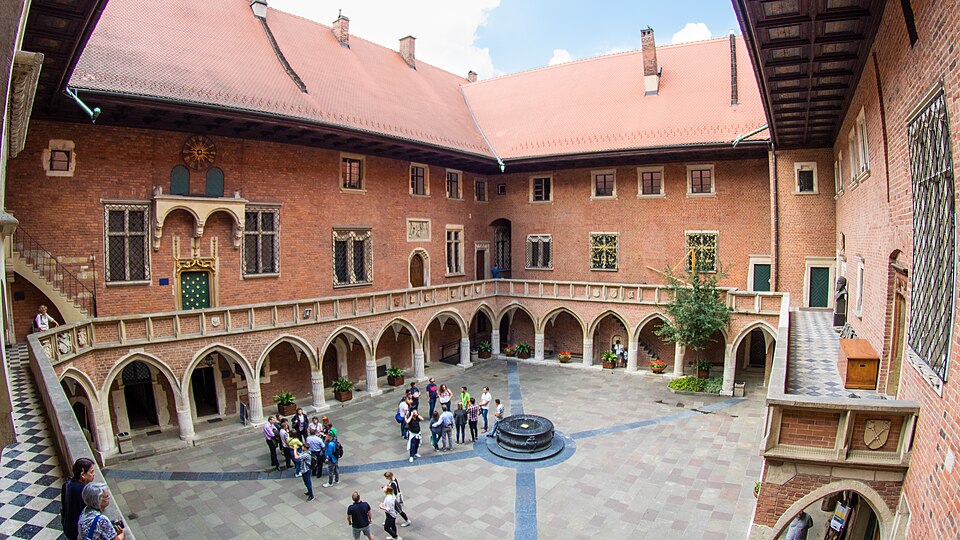
Walking through the Gothic courtyard of Collegium Maius today, visitors can imagine the generations of students who once crossed the same stone paving carrying manuscripts instead of laptops, discussing philosophy instead of podcasts, yet sharing the same curiosity about the world.
That continuity is perhaps Jagiellonian University’s greatest achievement. While methods of teaching have changed dramatically over more than six centuries, the pursuit of knowledge remains at the heart of the institution’s mission.
Preserving Knowledge Through Changing Times
Like Kraków itself, Jagiellonian University has experienced periods of prosperity, uncertainty and remarkable resilience. As the political landscape of Europe changed, so too did the role of the university.
The end of the Polish-Lithuanian Commonwealth and the partitions of Poland in the late eighteenth century transformed the country’s future. Although Poland disappeared from the political map of Europe for more than a century, Jagiellonian University continued to operate, adapting to changing administrations while remaining a centre of Polish scholarship.
During the period of Austrian rule, the university underwent reforms that modernised its organisation and broadened its academic scope. At the same time, it became an important guardian of the Polish language, literature and national identity.
For many students and academics, the university represented more than a place of education. It was a community where Polish culture and intellectual traditions could continue to flourish despite the country’s loss of independence.
Throughout the nineteenth century, Kraków earned a reputation as one of the leading centres of Polish intellectual life. Writers, artists, historians and scientists gathered in the city, contributing to a vibrant cultural scene that extended well beyond the university walls.
Even today, the cafés surrounding the university district echo this tradition. Conversations about literature, politics, science and culture remain part of everyday life, continuing a legacy that stretches back hundreds of years.
The Tragedy of Sonderaktion Krakau
One of the darkest chapters in the university’s history began shortly after the outbreak of the Second World War.
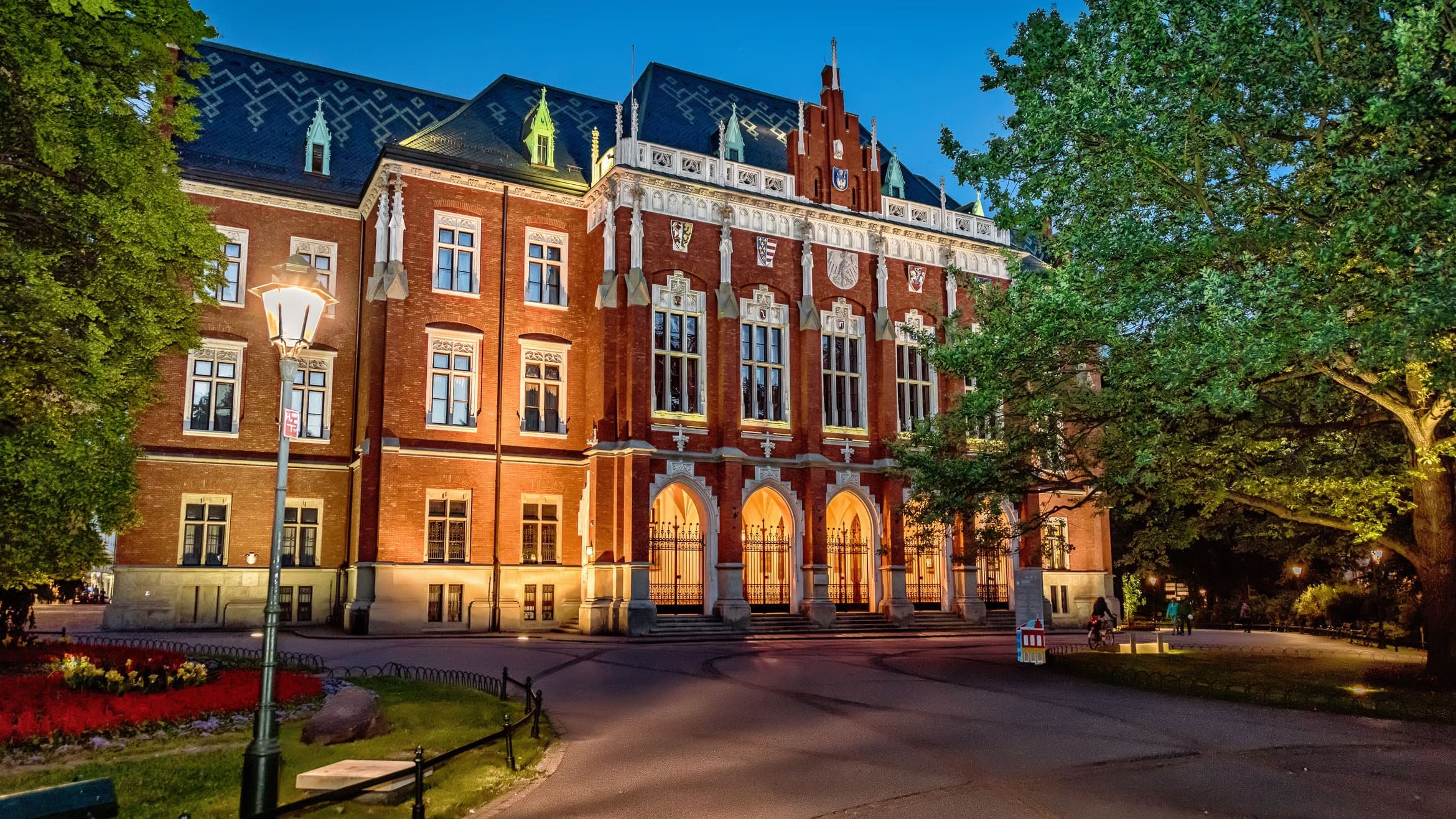
On 6 November 1939, German occupation authorities invited professors and lecturers to what appeared to be an official meeting at Collegium Novum. Instead, nearly 180 professors and members of university staff were arrested in a carefully planned operation known as Sonderaktion Krakau.
The operation formed part of a wider attempt to eliminate Poland’s intellectual and cultural leadership. Universities were closed, libraries were threatened, and higher education was deliberately suppressed.
Yet the determination to continue learning proved stronger than oppression.
Many academics took part in underground education, holding secret classes despite the enormous personal risk involved. Students continued their studies in private homes and hidden locations, ensuring that knowledge was passed from one generation to the next even during wartime.
Each year, the university commemorates the victims of Sonderaktion Krakau, reminding new generations of the importance of academic freedom and the courage shown by those who refused to abandon education in the face of persecution.
Rebuilding for a New Era
Following the end of the Second World War, Jagiellonian University entered another period of renewal.
As student numbers increased, the university expanded beyond its historic buildings in the Old Town. New faculties were established, research institutes developed, and modern laboratories built to support scientific discovery across a growing range of disciplines.
Historic colleges such as Collegium Maius and Collegium Novum remained central to the university’s identity, while newer campuses reflected the changing needs of contemporary higher education.
Today, the university comprises sixteen faculties covering subjects from medicine and life sciences to law, humanities, physics, chemistry, social sciences and international studies.
Its libraries contain millions of books and manuscripts, preserving priceless collections while providing access to the latest academic research. Meanwhile, the modern 600th Anniversary Campus has become one of Poland’s leading centres for scientific research and innovation.
The blend of medieval architecture and state-of-the-art research facilities perfectly illustrates how the university continues to balance tradition with progress.
A Living Part of Kraków
Unlike many historic landmarks that serve primarily as museums, Jagiellonian University remains very much alive.
Every autumn, thousands of students fill the streets around Collegium Maius, the Planty and neighbouring districts, bringing fresh energy to one of Europe’s oldest university cities.
Bookshops, independent cafés, cultural venues and museums all benefit from the presence of a large academic community. Public lectures, concerts, exhibitions and scientific events regularly open the university’s work to residents and visitors alike.
For tourists, the university offers an opportunity to experience living history rather than simply observe it. The beautifully preserved Collegium Maius Museum provides a glimpse into medieval academic life, while the surrounding streets reveal how closely the institution has remained connected to the daily life of Kraków.
It is this combination of heritage and modern scholarship that makes the university such an important part of the city’s character.
An International Reputation Built Over Centuries
More than 650 years after King Casimir the Great signed the university’s founding charter, Jagiellonian University continues to rank among Poland’s leading institutions for teaching and research.
Its researchers collaborate with universities and scientific organisations across Europe and beyond, contributing to advances in medicine, biotechnology, environmental science, artificial intelligence, physics and the humanities.
Thousands of international students choose Kraków each year, attracted not only by academic opportunities but also by the chance to study in one of Europe’s most historic university cities.
Despite its global outlook, the university has never lost sight of its roots. Medieval traditions continue alongside modern graduation ceremonies, while historic buildings remain active places of learning rather than monuments frozen in time.
Why Jagiellonian University Still Matters
Jagiellonian University is far more than a collection of historic buildings or a name in the history books.
It tells the story of Kraków’s resilience, Poland’s determination to preserve knowledge through difficult times, and the enduring value of education across generations.
From the vision of King Casimir the Great and the generosity of Queen Jadwiga to the courage of professors who continued teaching during wartime, every chapter of the university’s history reflects a belief that learning has the power to shape society.
For visitors exploring Kraków, the university offers far more than impressive Gothic architecture. It provides a deeper understanding of how the city became one of Europe’s great centres of culture, science and scholarship.
More than six centuries after its foundation, students still pass beneath the same stone archways, lectures continue within historic walls, and discoveries are made in laboratories across the city. It is a reminder that history is not only something to admire but something that continues to be written every day.
Did You Know?
- Jagiellonian University was founded in 1364, making it the oldest university in Poland.
- It is one of the oldest continuously operating universities in Europe.
- Queen Jadwiga’s bequest helped secure the university’s future after her death in 1399.
- Nicolaus Copernicus studied at the university between 1491 and 1495, although he did not graduate there.
- Collegium Maius is the oldest surviving university building in Poland.