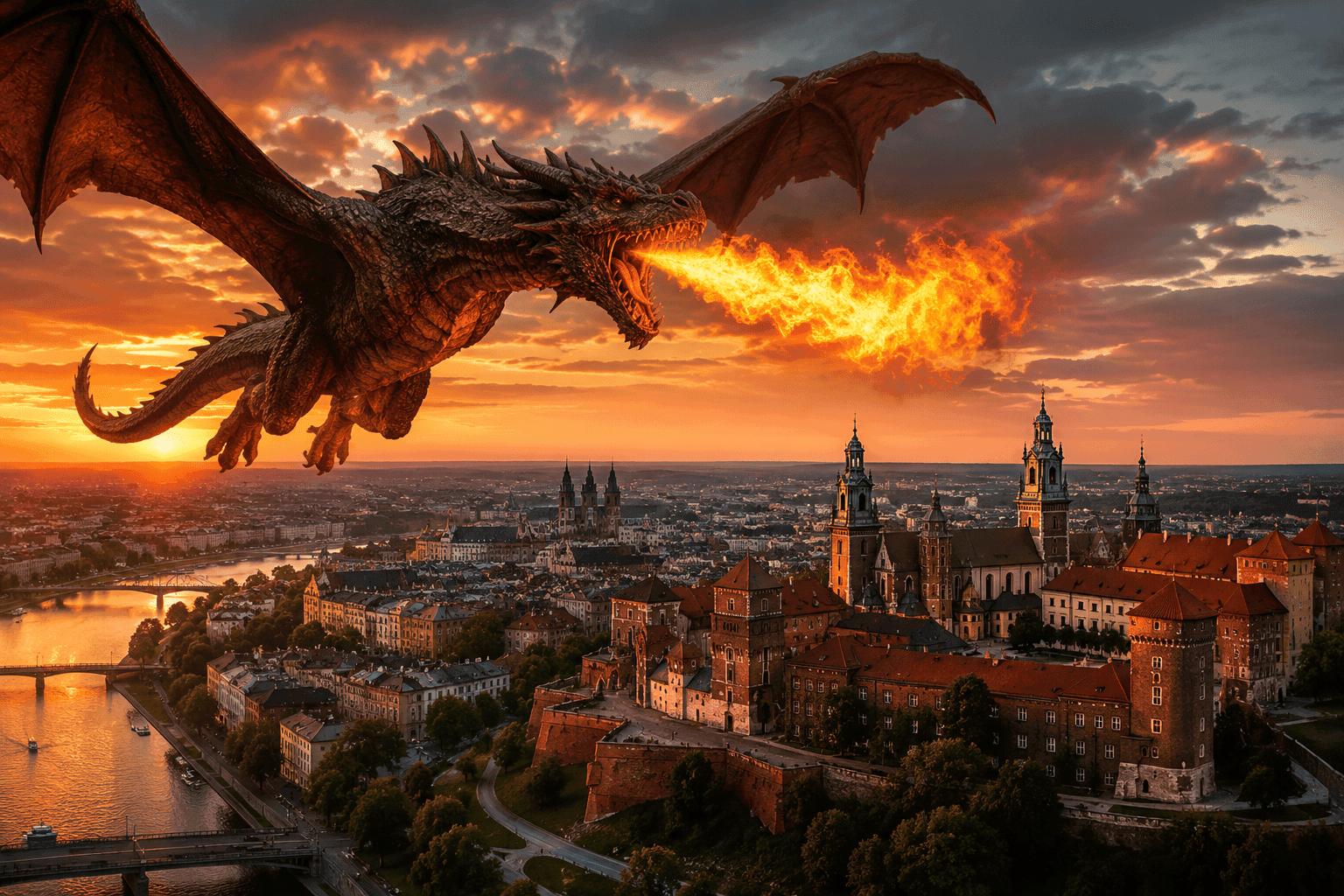
Discover the fascinating history of the Wawel Dragon, the legendary creature that has become the enduring symbol of Kraków. Explore the origins of the myth, its evolution through the centuries and where visitors can experience the legend today.
Few stories are as closely woven into the identity of Kraków as the legend of the Wawel Dragon. For centuries, this fearsome creature has captured the imagination of residents and visitors alike, becoming a symbol of the city’s rich heritage rather than simply a character from folklore. Today, the dragon welcomes millions of tourists each year from its perch beside the Vistula River, where a fire-breathing statue stands beneath the walls of Wawel Hill.
While many know the familiar tale of a clever shoemaker defeating the beast, the legend has a much longer and more fascinating history. Its origins stretch back to medieval chronicles, and over the centuries, the story has evolved into one of Poland’s best-loved legends.
A Dragon Beneath Wawel Hill
According to tradition, a terrifying dragon once lived in a cave beneath Wawel Hill, where Kraków’s Royal Castle now stands. The creature terrorised the surrounding settlement, devouring livestock and, in some versions of the story, demanding even greater sacrifices from the local population.
Many brave warriors attempted to defeat the beast, but none succeeded. The dragon’s strength seemed impossible to overcome, leaving the people living in constant fear.
Everything changed thanks to an unlikely hero.
Rather than relying on force, a young shoemaker named Skuba devised a clever plan. He filled a sheep’s skin with sulphur before leaving it outside the dragon’s cave. The dragon eagerly swallowed the bait, only to be overcome by an intense burning thirst. It drank vast quantities of water from the River Vistula until, unable to quench its thirst, it finally burst apart.
With the dragon defeated, peace returned to the settlement, and the future city of Kraków was free to flourish.
Although this version has become the best known, it is only one chapter in a legend that has been retold and reshaped for more than 800 years.
The Story’s Medieval Origins
The earliest surviving account of the Wawel Dragon appears in the writings of the medieval chronicler Wincenty Kadłubek at the turn of the 13th century.
His version differs significantly from the story most people know today. Instead of a humble shoemaker, it is the sons of the legendary ruler Prince Krak who devise a way to destroy the dragon. After their victory, however, the story takes a darker turn as one brother murders the other out of jealousy before attempting to claim all the glory for himself.
Rather than ending as a simple tale of good triumphing over evil, Kadłubek’s account serves as a moral lesson about ambition, betrayal and the consequences of deceit.
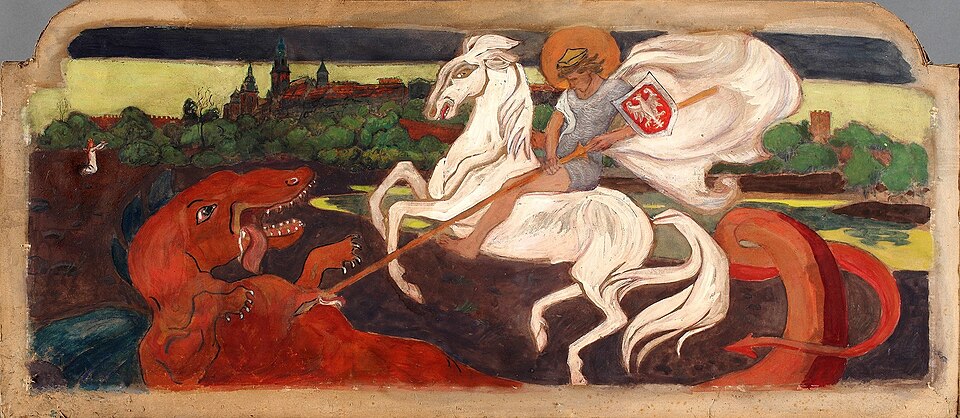
Over the following centuries, other historians adapted the story. Jan Długosz later credited King Krak with slaying the dragon, while the character of Skuba the shoemaker was introduced during the Renaissance by historian Joachim Bielski. It was this version, celebrating intelligence over strength, that eventually became the legend most familiar today.
Why Dragons?
Dragon stories appear in cultures across Europe, but the Wawel Dragon occupies a unique place in Polish folklore.
Historians believe the legend may combine several influences, including local cave traditions, early Slavic mythology and medieval Christian symbolism. The natural limestone cave beneath Wawel Hill, now known as Smocza Jama or Dragon’s Den, almost certainly helped inspire stories long before they were ever written down.
Like many legendary creatures, the dragon can also be viewed as a symbol. It represents the dangers faced by early settlements, the unknown forces of nature or the chaos that threatened communities before civilisation became firmly established.
The story’s enduring message is equally significant. Victory is achieved not through superior strength, but through intelligence, creativity and determination. It is this emphasis on ingenuity that has helped the legend remain relevant across generations.
The Dragon’s Den
One of the reasons the legend continues to resonate is that visitors can still experience the setting for themselves.
Smocza Jama lies beneath Wawel Hill and forms part of the limestone caves that have existed for thousands of years. Visitors descend through the hill before emerging near the banks of the Vistula, following the route traditionally associated with the dragon’s home.
Whether or not anyone believes a dragon ever lived there is almost beside the point. The cave provides a tangible link between history, folklore and the landscape that inspired one of Poland’s greatest stories.
A Symbol of Modern Kraków
Outside the Dragon’s Den stands one of the city’s most photographed landmarks.
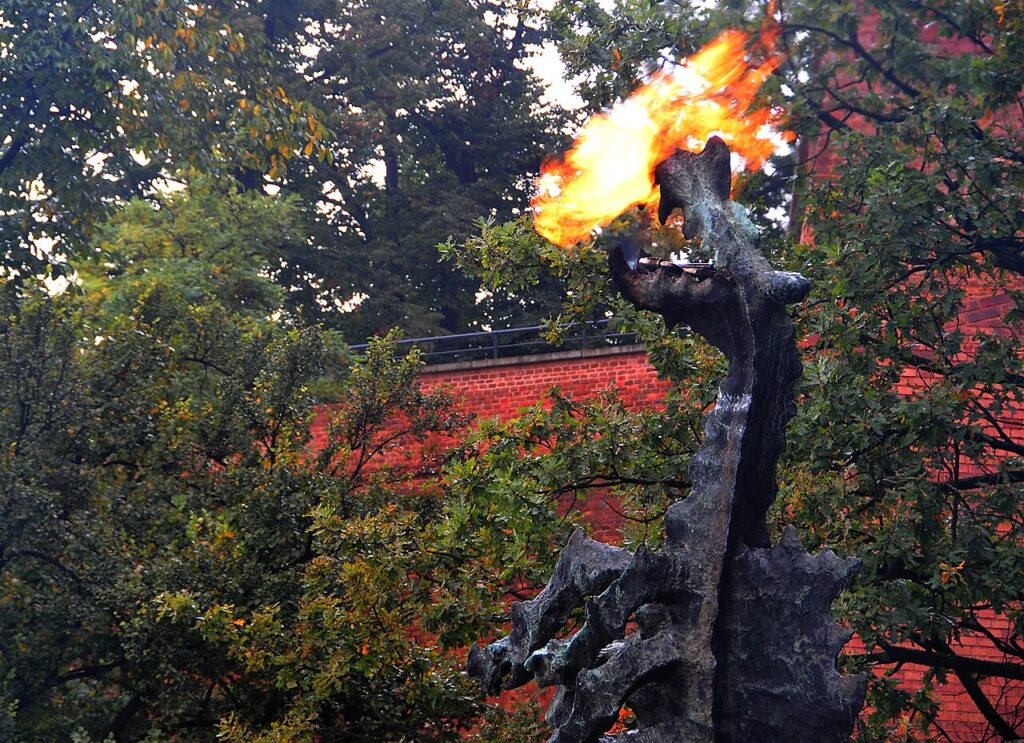
Designed by sculptor Bronisław Chromy and unveiled in 1972, the bronze Wawel Dragon has become an icon in its own right. At regular intervals, the sculpture breathes real flames, delighting children and adults throughout the day.
The dragon’s image now appears across the city on souvenirs, public artwork, children’s books and educational materials. It has become inseparable from Kraków’s identity, representing not fear, but imagination, resilience and civic pride.
Each year, the city also celebrates its legendary resident during the Great Dragon Parade, when colourful dragon-themed performances and giant floating creations transform the banks of the Vistula into one of Kraków’s most popular family events.
Fact, Folklore and Curiosity
There is no historical evidence that a dragon ever inhabited Wawel Hill, yet the legend has inspired scientific curiosity as well as storytelling.
In an intriguing twist, palaeontologists discovered the remains of a large prehistoric predator in southern Poland and named it Smok wawelski, or the Wawel Dragon, in honour of the famous legend. Although the animal lived around 210 million years ago and has no connection to medieval Kraków, the name reflects the enduring influence of the city’s best-known myth.
More Than a Fairy Tale
The legend of the Wawel Dragon has survived because it is more than a simple children’s story. It connects Kraków’s landscape with its earliest traditions, blending history, mythology and imagination into a narrative that continues to define the city today.
For residents, it is a reminder of Kraków’s remarkable cultural heritage. For visitors, it offers an engaging introduction to the city’s past before they even step inside Wawel Castle. And for generations of children, the dragon remains the unforgettable guardian of one of Europe’s most beautiful historic cities.
Whether encountered in medieval chronicles, inside the Dragon’s Den or through the burst of flame from the famous statue beside the Vistula, the Wawel Dragon continues to ensure that Kraków’s oldest legend is very much alive.
Read more about Krakow history here!